When Alexander Meininger, a talented photographer based in London, welcomed his children into the world, he discovered a newfound appreciation for playgrounds. His natural curiosity led him to build an indoor treehouse for his sons, but it wasn't until he witnessed the heart-wrenching displacement of children during the war in Ukraine that he truly understood the profound significance of play.
This realization inspired Meininger to create Playrise, a nonprofit organization dedicated to providing modular, packable play equipment and furniture for children living in disaster zones and refugee camps. With a joyful mission at its core, Playrise aims to bring happiness and normalcy to those facing challenging circumstances.
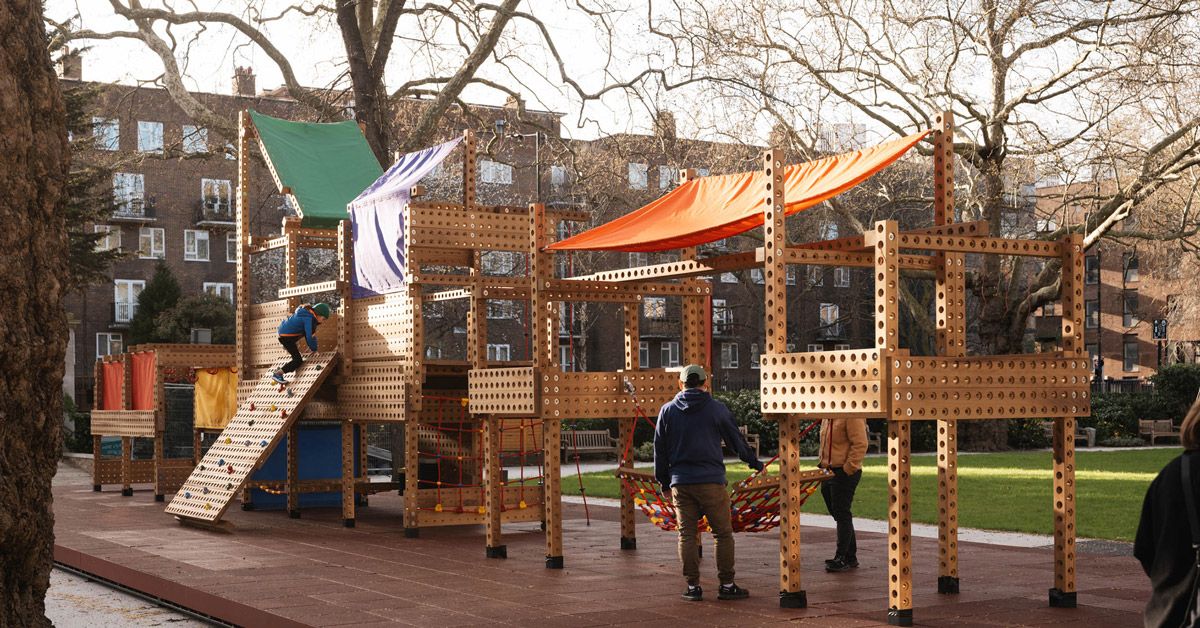
Collaborating with the innovative architecture studio OMMX, Meininger designed delightful play structures made from simple wooden components. These structures can be easily assembled and personalized with vibrant accessories like monkey bars, hammocks, basketball hoops, and climbing ropes, allowing for a unique play experience tailored to the needs of each community.
Playrise structures are fully customizable, ensuring they can be reconfigured to suit various locations while allowing for easy maintenance. The design team even consulted with Sudanese, Palestinian, and Eritrean child refugees to understand what elements would bring joy and fulfillment to their playtime. Their insights reinforced a powerful truth: play is essential for a child's development.
In refugee camps, many children face the challenges of displacement, trauma, and lack of access to education and healthcare. As Playrise notes, "In such circumstances, play is a lifeline, helping children relieve stress, foster nurturing relationships, and re-establish conditions in which learning can occur."
Initially, Meininger envisioned using rubble from disaster areas to construct the play structures. However, he soon recognized that these communities needed something that was “affordable, quick, and easy to assemble.” Just as one might prefer ready-made furniture when renting a home, refugee camps require adaptable solutions that can easily be set up and taken down.
Determined to create a solution that is both scalable and meaningful, Meininger and the OMMX team traveled to Aysaita, Ethiopia, the first refugee camp to receive a prototype of Playrise's innovative playground. Here, 10,000 children under the age of ten live without access to any playground facilities. During their visit, the designers engaged with local children and families to co-create the play structures, ensuring that their voices were heard.
In Aysaita, families reported that their children even participated in constructing the sample play structures, actively contributing to their community. Hikaru Nissanke, director of OMMX, expressed the importance of this involvement: “We’re equipping them with the practical skills they will one day need in order to build and maintain their own homes.”
Safety and comfort were priorities in the design process, leading to the decision to use timber instead of metal, which can become uncomfortably hot in desert climates. The structures were thoughtfully designed to prevent injuries, accommodating various terrains and ensuring that children can play freely and safely.
As Playrise beautifully describes, “The simple modular kit comprises elements which allow for play for different ages, abilities, personalities, and settings. Some configurations focus on dynamic movement and popular games, while others encourage more sensory forms of play.” With these versatile designs, children can create a playground, a theater, a tunnel, or a safe space to call their own.
Excitingly, Playrise is set to begin deploying its structures within the next month, with plans to provide international aid organizations with a "menu" of playground parts and structures to bring joy to children in various regions. Nissanke emphasized the importance of avoiding a patronizing approach, highlighting that regardless of location, all families share a common desire: to see their children thrive and play.
As the Ethiopian community prepares to welcome Playrise, representatives have also identified refugee camps in Cairo and Wadi Karkar as the next locations for this uplifting initiative. Ultimately, Playrise encapsulates the belief that "Play is not a luxury, or a nice-to-have… It is often in the playground that we forge the connections and peer relationships on which society is founded."
In the end, Meininger and his team remind us that while our birthplace may be random, the right to play safely is a fundamental aspect of childhood that everyone deserves.