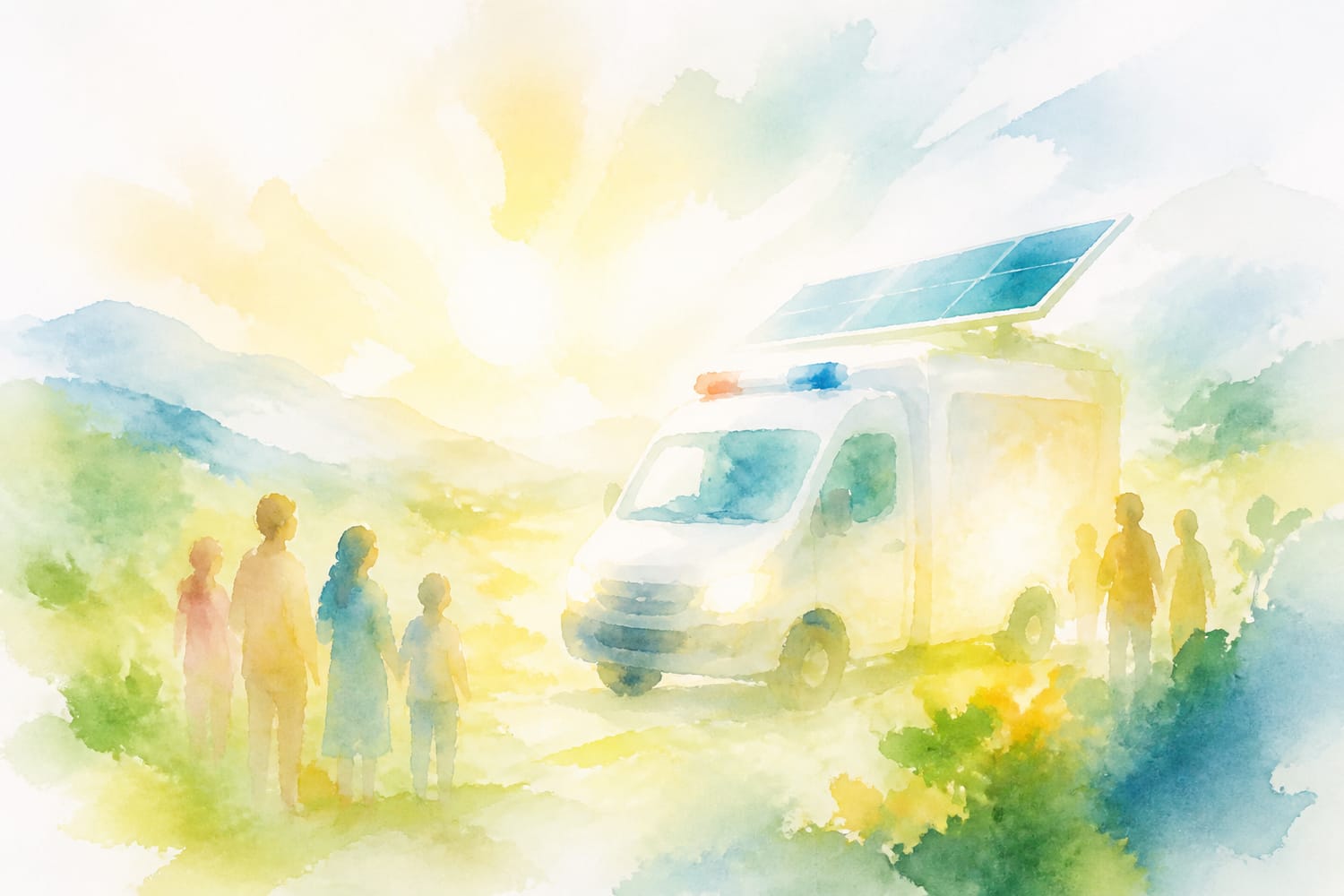
Students Unveil Solar-Powered Ambulance Designed To Bring Healthcare Anywhere
A bright new approach to mobile healthcare arrived in July 2026, when students from Eindhoven University of Technology in the Netherlands introduced what is believed to be the world’s first solar-powered ambulance.
Named Stella Juva, the innovative vehicle represents a hopeful vision: bringing essential medical services to people in remote communities without relying on conventional fuel or a dependable electrical grid.
Nearly two dozen student engineers and designers from Solar Team Eindhoven worked together on the project, drawing inspiration from a shared commitment to accessible healthcare and sustainable technology.
“We were inspired by the United Nations’ Sustainable Development Goals, which strive to make good healthcare accessible to everyone,” 21-year-old team manager Mathijs van Gerven said in a statement.
“Stella Juva is fully equipped to deliver medical healthcare in hard-to-reach areas.”
A medical center powered by sunshine
With its angular white-and-yellow body, Stella Juva has a futuristic appearance. Its most meaningful features, however, are found in its ability to travel long distances and support medical professionals wherever they are needed.
Solar panels built into the roof generate energy for both the vehicle and its onboard medical equipment. In sunny conditions, the ambulance can reach approximately 75 miles per hour and is expected to travel around 445 miles.
Inside, healthcare workers have access to vital equipment, including X-ray machines and defibrillators. Stella Juva also carries tuberculosis testing kits, ultrasound devices for pregnant patients, and refrigerated storage for vaccines.
Although the vehicle has two interior seats, it can become a larger treatment space after arriving at its destination. A tent and folding chairs can be set up beside the ambulance, allowing medical teams to care for patients on-site.
Created with real communities in mind
To ensure Stella Juva could respond to genuine healthcare challenges, the students collaborated with international health organizations, including Amref Health Africa, formerly known as Flying Doctors.
“For millions of people, good healthcare remains out of reach. Access to care shouldn’t depend on whether there’s access to electricity or fuel,” Femke Maurits, partnerships manager for Amref Health Africa in the Netherlands, said in a statement.
“Amref Health Africa has been working for almost 70 years to make healthcare in Africa better and more accessible. In remote areas, healthcare workers sometimes travel great distances by bicycle, and reliable energy is not a given,” Maurits added.
“That’s why we’re proud to explore together with Solar Team Eindhoven how solar-powered innovation can bring healthcare closer to people who currently have almost no access to it.”
Preparing for real-world testing in Kenya
Stella Juva is more than an inspiring student prototype. The solar ambulance will be deployed in Kenya, where the team plans to study how effectively it can operate in different remote settings.
“In several remote areas, healthcare scenarios will be simulated, such as the treatment of patients with tuberculosis. This allows the team to evaluate how effectively the solar-powered ambulance performs in real-world conditions,” a press release explained.
“During the testing phase, the team will visit two field locations where the treatment of patients will be simulated. At the same time, the team expects to cover hundreds of kilometers with Stella Juva, powered entirely by solar energy.”
These trials will give the students and their healthcare partners valuable insight into how the vehicle could support medical teams and patients in places where transportation, electricity, and fuel are difficult to access.
A joyful example of technology serving people
The path beyond Stella Juva’s testing phase has not yet been determined, but its young creators are already demonstrating what can happen when technical knowledge is guided by compassion.
“Together with healthcare organizations, we’re developing a vehicle that fits real-world practice. We hope to improve healthcare access, and make it more sustainable,” Yarno Basten, partnerships manager for Solar Team Eindhoven, said in a statement.
“We want to inspire healthcare providers, companies, and other organizations to create social impact through technology. If 23 students can achieve this in a single year, it shows what's possible when the technological industry and social organizations work together.”
With sunlight as its power source and human well-being as its purpose, Stella Juva offers an encouraging glimpse of a future in which thoughtful innovation helps bring quality healthcare closer to everyone.