Above the M1, a New Wildlife Bridge Brings Two Sydney Wildernesses Back Together
South of Sydney, a hopeful new chapter is opening for wildlife. A redesigned overpass on the M1 Princes Motorway is now helping reconnect Heathcote National Park with Royal National Park, giving animals a safer way to move between two important bushland areas that have long been divided by one of Australia’s busiest roads.
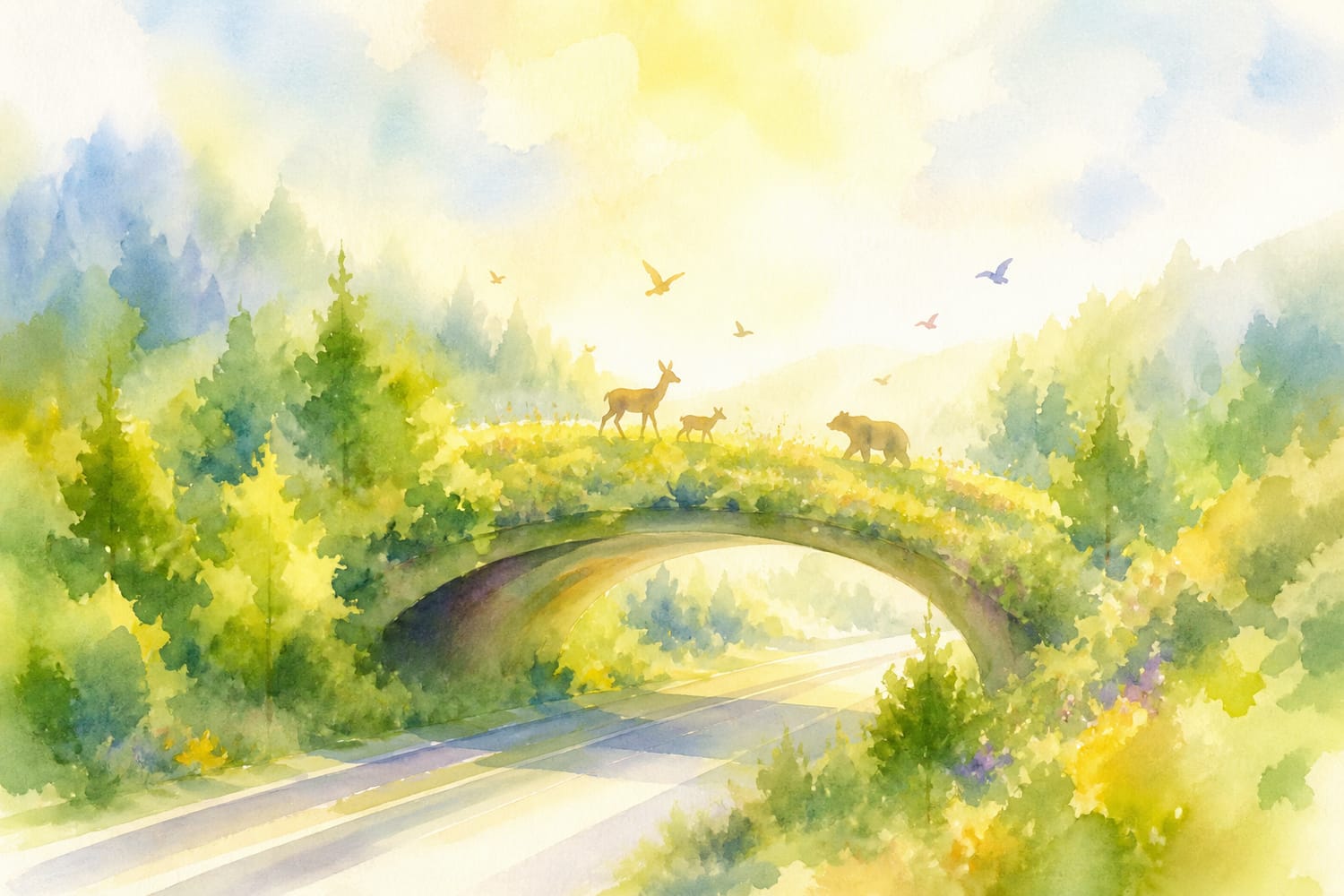
The Cawleys Bridge retrofit has turned a plain maintenance bridge into a carefully planned wildlife crossing. It includes rope pathways for gliding and tree-dwelling marsupials, wooden routes for animals that travel just above the ground, and planted corridors for species such as wombats, echidnas, amphibians, insects, reptiles, koalas, and quolls.
For conservationists, the bridge is more than infrastructure. It is a practical act of care for native animals in a changing landscape.
A Safer Route Through a Busy Corridor
Each day, around 40,000 vehicles travel this section of the M1 Princes Motorway, the major route linking Sydney with industrial areas to the south in New South Wales. Cars and trucks move quickly along the four-lane road, which sits between Heathcote National Park on one side and Royal National Park on the other.
For animals such as the spotted-tailed quoll, that road has been a serious barrier. The quoll, a cat-sized native predator with a tawny coat and white spots, may need to cross to find food, mates, and new territory. But a highway carrying vehicles at speeds of up to 110 kilometers per hour, or 68 miles per hour, can function almost like a canyon.
For decades, many animals have died trying to cross this stretch of road, including quolls, wallabies, deer, koalas, and other species. More than 200 larger animals were recorded killed over five years, though the real number is likely higher because smaller species are harder to count.
Now, above the traffic, a gentler option is in place.
Turning Concrete Into Habitat
On Cawleys Bridge, fresh soil, native plants, logs, ropes, ramps, and fencing have transformed an ordinary structure into a living corridor. The overpass is designed to feel familiar and safe to many different kinds of animals.
Before the retrofit, monitoring showed that wildlife had little reason to use the bare bridge.
“When we monitored it, in [Australian] winter, nothing was using it,” said Kylie Madden, an ecologist with the New South Wales Environment and Heritage agency. “In summer, we did get a few crossings of these goannas [lizards], and we had one ringtail possum. But it was such an unfriendly situation.”
That has now changed. The bridge has been reshaped with animal behavior in mind, and motion-sensing cameras have been installed to track which species use it and how often.
High above the bridge deck, thick ropes provide aerial routes for animals such as sugar gliders and common ringtail possums, which naturally prefer moving through branches rather than crossing exposed ground.
“There’s absolutely no way a sugar glider will make it across that road without connection,” Madden said.
Below those ropes, wooden paths offer another option for animals such as reptiles and koalas. At ground level, soil and native vegetation create a sheltered passage for wombats, echidnas, amphibians, and insects. Fencing on either side helps guide animals toward the bridge and away from traffic.
“We’re trying to make this functional for everything,” Madden said.
That includes very small and vulnerable species. The endangered red-crowned toadlet lives close to the bridge among damp ferns and understory plants.
“There are endangered species, like the red crowned toadlet [Pseudophryne australis] within just 10 meters [33 feet] of this bridge,” Madden said. “But they are never crossing without this structure.”
Rejoining Royal National Park With the Wider Bush
The bridge is especially important because of what it reconnects. Royal National Park, opened in 1879, is the world’s second-oldest national park. Yet despite its size, it has become increasingly cut off. The Pacific Ocean lies to the east, while a broad sweep of bushland extends west across the Woronora Plateau toward the Eastern Highlands.
The M1 sits between those landscapes.
“It’s iconic,” Madden said of Royal. “But what it’s not connected to — because of the M1 — is this vast tract of wilderness.”
That separation matters. Wombats are now nearly gone from Royal National Park, Madden said, though they remain more common west of the road. Koalas were once found in the park, but today they have almost disappeared from it.
“There’s habitat there,” Madden said, “but almost no koalas.”
Some koala populations remain on the eastern side, but without safe ways to move, they cannot easily recolonize Royal National Park. That is especially important after major disturbances such as the 1994 fire that burned more than 90% of the park.
As climate change contributes to hotter and drier conditions, bushfires in Australia have become more frequent, intense, and extensive, according to CSIRO, the country’s federal science agency. Connected reserves can help animals escape, survive, and return.
“We need to really make sure our reserves are connected,” Madden said, “for all species … to make them as resilient as possible for the future.”
Scientists around the world increasingly emphasize that fragmented habitats can leave wildlife populations isolated and vulnerable. As biologist Stuart Pimm and colleagues wrote, “Even when natural habitats remain, they often come in fragments too small or isolated to sustain viable populations.”
When animals can move across their full range, they can find food, avoid inbreeding, choose from more mates, and maintain healthier genetic diversity. That gives populations a better chance to withstand disease, environmental change, and future fires.
A Long-Held Idea Becomes Reality
Cawleys Bridge is the result of many years of persistence and cooperation. Bob Crombie, a former Royal National Park ranger and retired ecologist, first raised the idea in 1974. Later, local groups including a branch of the Country Women’s Association and the National Parks Association supported the vision. In 2021, the Sutherland Shire Environment Centre joined the effort, and work with Transport NSW helped move the project forward.
Public concern for koalas also gave the proposal momentum.
“In 2022, the idea of retrofitting Cawleys Bridge to reconnect Heathcote and Royal National Park came up in discussions,” Sally Webb, an official at Transport NSW, told Mongabay in an email.
Webb said transport and environment agencies now meet regularly “to discuss how we can contribute to implementing the NSW Koala Strategy.”
The NSW Koala Strategy, launched in 2021, focuses on protecting koalas and their habitat. It helped fund the bridge conversion, including nearly $600,000 for construction and maintenance and about $54,000 for monitoring.
By late 2023, four government agencies had approved the project internally. The finished bridge now combines several crossing methods in one place: fencing, ramps, vegetation, logs, climbing structures, and aerial ropes.
Cawleys is only the second wildlife bridge in the Sydney area, a region rich in biodiversity. It is also the only one linking disconnected landscapes between national parks.
Across the heavily populated east coast of Australia, wildlife crossings remain relatively uncommon. Transport NSW has recorded more than 25,000 animal uses of 10 crossings, most of them underpasses. Agency data from 29 road projects show at least 67 species using crossings, including threatened animals such as koalas and spotted-tailed quolls, along with more common species such as emus.
Crossings Work Best When They Respect Animal Needs
Wildlife crossings are increasingly recognized as a powerful way to soften the impact of roads on nature.
“One of the primary drivers of global landscape fragmentation is road construction,” said wildlife ecologist Brendan Taylor, author of The Evolution of Wildlife Crossings in Eastern Australia.
Taylor compared roads to “casting a net over the landscape, with each road separating formerly connected habitats.”
The idea draws from Road Ecology: Science and Solutions, the influential 2003 book by Richard T.T. Forman and other ecologists.
“That book was part of the growing movement to better understand and assess the impact of roads on wildlife populations,” Taylor said.
Crossings, whether bridges or underpasses, can help “perforate the roaded corridor,” Taylor added, allowing animals to move, feed, and breed.
When paired with fencing that keeps wildlife off the road and guides animals toward safe passage, research shows these structures can reduce collisions and animal deaths. Around the world, such solutions are becoming more common. Europe has thousands of wildlife crossings, including 600 in the Netherlands. The United States and Canada have more than 1,000. Other examples include a primate canopy bridge in the Brazilian Amazon, elephant underpasses in Kenya, and green bridges in Singapore.
Still, successful crossings must be designed for the species expected to use them.
Conservation biologist Ross Goldingay has spent decades studying animals such as the eastern pygmy possum, a tiny tree-dwelling marsupial found in eastern Australia. Though small, pygmy possums can move up to 1,640 feet in a night and help pollinate plants as they feed on nectar and pollen. Like many forest animals, they often avoid exposed open areas.
“If you want to try and maintain connectivity, you need to assist these animals. So how do you get them over a road?” Goldingay asked.
His work has shown that animals need crossings that match their habits. Tall wooden poles can help gliding possums cross gaps in tree cover. Underpasses can work well for many mammals. Rope bridges can support arboreal species such as squirrel gliders. Koalas and some reptiles may need different structures again.
“Landscaping really matters,” Goldingay said.
He has found that vegetation and cover can make a major difference.
“where you’ve got the vegetation coming up … you’ll get more animals passing through.”
Even simple culverts can help. In one Transport NSW study, Taylor and colleagues recorded 36 species, from frogs to wallabies, using drainage pipes about 3 feet wide to pass beneath roads. New fauna-sensitive road construction guidelines in New South Wales now include larger culverts where suitable, offering a practical and less expensive option in some locations.
A Living Pathway for the Future
With construction complete, Cawleys Bridge now rests above the steady movement of motorway traffic as a carefully made link between two great natural areas. The cars below still move quickly, but above them is soil, vegetation, timber, rope, and possibility.
Wildlife may take time to discover and trust the route. Studies show animals can learn to use crossings, remember them, and pass that knowledge to their young.
“Animals learn to use these pathways over time,” Madden said, “and that’s what a passage across a dangerous roadway is” — a pathway.
For spotted-tailed quolls, koalas, sugar gliders, wombats, amphibians, insects, reptiles, and many other creatures, Cawleys Bridge offers something wonderfully simple and deeply valuable: a safer way forward.